Artificial Intelligence in the prevention of money laundering: the new standard to combat financial crime in Latin America
From my role at Sentinel, working closely with banks, cooperatives, fintechs, issuers, and payment processors across the region, I see a common pattern:
Entities that are adopting AI are not only improving their ability to detect money laundering, but are completely transforming their understanding of risk.
In this article, I want to share a clear and concise overview of how AI is redefining AML in Latin America, what advancements are already available, and how this technology is integrated into tools like Sentinel to support institutions against increasingly sophisticated threats.
Money laundering in Latin America: more dynamic, more digital, and harder to detect.
Latin America faces a scenario where the following converge:
• Increase in transnational organized crime
• Expansion of digital economies and fintechs
• Increase in mobile money and wallets
• New digital routes and typologies
• Operations in multiple jurisdictions
Today, money laundering moves with more speed and discretion than ever before. Criminal organizations use:
• Digital mule accounts
• Automated microtransactions
• P2P platforms
• Wallet-to-wallet transfers
• Structuring disguised as e-commerce
The consequence is clear:
Systems based solely on static rules are no longer sufficient.
Criminals know them, test them, and easily evade them.
This is where AI makes the difference.
Why is Artificial Intelligence now indispensable in AML?
Artificial Intelligence allows the system to learn from real-world behavior, detect hidden patterns, identify anomalies, and respond in real time to emerging threats.

AI sees what the rules don’t

Adapts to new typologies without reprogramming the system

Dramatically reduces false positives

Increase the effectiveness of compliance teams
Esto es especialmente crucial en una región con:

High transaction volumes

Regulatory heterogeneity

Financial ecosystems undergoing rapid digitalization
AI Capabilities That Are Transforming AML/CFT Prevention Today
Leading entities are already adopting models that combine several capabilities simultaneously. These include:
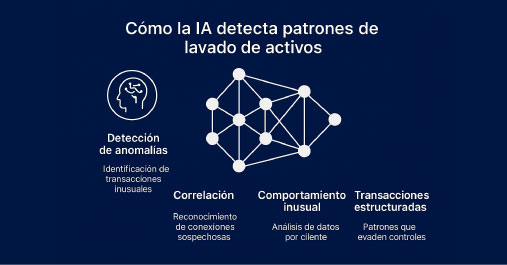
2. Dynamic risk models
AI recalculates customer risk based on their actual behavior, not just their initial static profile.
3. Digital structuring and microtransactions
Detects splitting across multiple channels or entities, even when individual amounts don’t trigger traditional alerts.
4. Advanced customer segmentation
Groups customers with similar behaviors to detect more accurate deviations.
5. Reduction of false positives
AI learns which alerts were historically legitimate or dismissed and adjusts the model, generating greater efficiency in teams.
6. Intelligent alert prioritization
AI orders alerts based on risk probability, not rigid rules.
7. Automation of investigations
AI pre-constructs part of the analysis:
• Relationships between accounts
• Transactional history
• Frequency of operations
• Indirect links
8. Detection of new typologies
Learn from real data and recognize emerging behaviors that previously went unnoticed.
New types of money laundering detected in Latin America where AI makes a difference
Payment accounts in wallets and payment apps
Newly created accounts with intensive activity for a few days.
Cross-border movements without commercial correlation
Flows between unrelated countries with no historical pattern.
Payment accounts in wallets and payment apps
Used as a layering.
Digital impersonation in onboarding
Account opening with documents legitimate but fake identities.
Mixing cryptocurrencies with bank transfers
Connections that were previously invisible to traditional models.
These typologies require models capable of understanding the behavior, not just amounts or preconfigured rules.
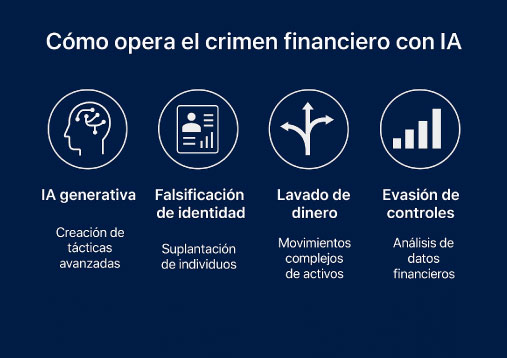
Criminals are also using AI: the emerging risk we cannot ignore.
Just as entities are using AI to protect themselves, criminal groups are also adopting it to:
• Create transactional patterns that are harder to detect
• Design better distributed fractional structures
• Automate movements to avoid traditional rules
• Generate more sophisticated fake identities
• Deceive biometric validation systems
• Mimic real behaviors to avoid triggering alerts
Today the clear message is:
The only way to combat AI-powered criminals is by using more advanced AI.
How AI integrated into Sentinel transforms your operation

Fraud Pattern Detection Using Machine Learning — Models trained with your institution’s own historical data identify atypical behavior and early signs of fraud, continuously adapting to new risk profiles.
AI-Generated Reports and Dashboards — Your teams can obtain visualizations and reports simply by describing the information they need in natural language, without relying on technical configurations or IT departments.
Integrated Intelligent Assistant — An AI chatbot resolves conceptual and functional questions about the system in real time, reducing the learning curve and dependence on technical support.
The future of AML in Latin America will be driven by AI
Financial institutions that advance along this path will be better prepared to:
|
• Respond to more demanding regulators • Act against typologies that change every month • Protect your reputation and that of your clients |
• Integrate into secure digital ecosystems • Prevent penalties and fines • Competing with technologically mature entities |
AI is no longer a futuristic innovation. It is the minimum standard required for a modern AML program.
Want to see how Sentinel AI can strengthen your program AML?
I invite you to request a personalized demonstration and learn how Our Artificial Intelligence capabilities help detect emerging typologies, reduce false positives, and strengthen your AML/CFT management.

Camila Sibaja
México, República Dominicana.

Ariana Hütt
Centro América, Colombia, Brasil, España.

Natalia Rodriguez
Ecuador, Chile, Argentina, Uruguay.
Autor
Oscar Eduardo Camelo
Sentinel Marketing Director.
We recommend

How to reduce internal fraud in financial institutions without increasing costs
How to reduce internal fraud in financial institutions without increasing costsInternal fraud continues to be one of the most silent but most costly risks for financial institutions in Latin America. Although much of the public conversation focuses on external...

The Culture of Integrity in Latin America
The Culture of Integrity in Latin America A commitment that evolves with technology.By Luana Cristina Romero de SouzaIn recent years, Latin America has undergone a profound transformation in financial integrity, regulatory compliance, and anti-money laundering....

Artificial Intelligence in Money Laundering Prevention
Artificial Intelligence in Money Laundering Prevention A New Era of Intelligent DetectionBy Luana Cristina Romero de SouzaMoney laundering remains one of the greatest threats to the integrity of global financial systems. As criminal networks become more sophisticated,...